NACA 4-digit family sheet at equal aspect
The NACA 4-digit aerofoil sections, computed analytically, varied one parameter per panel about the default section NACA 4412: the maximum camber \(m\), the chordwise position \(p\) of the maximum camber and the thickness \(t\). Each panel is drawn at equal aspect, so that one unit of chord has the same length along x and y and a 12 % thick section looks 12 % thick; the aspect is kept by shrinking each plot area to the fixed limits, which every panel shares through x and y links, with the same regular ticks. The long panel titles are aligned with the left edge of each plot area. The five members of each panel are told apart by five dash patterns, the default section being the solid line.
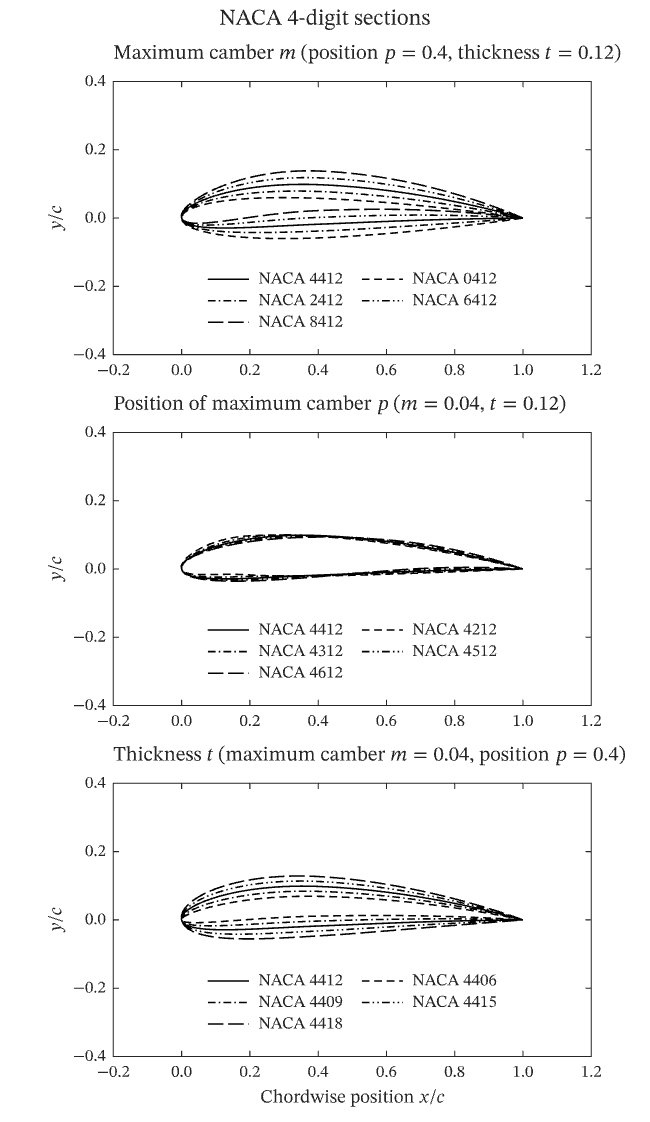
The figure above is live, drawn in the browser by the same engine that draws the viewer: drag it to pan, and click it to zoom with the wheel. Download the PDF for the vector figure that IronLAB exports, or read how to embed a figure of your own.
Source
The figure is built by the following code.
use ironlab::prelude::*;

pub const TITLE: &str = "NACA 4-digit family sheet at equal aspect";
pub const DESCRIPTION: &str = "The NACA 4-digit aerofoil sections, computed analytically, varied one parameter per \
     panel about the default section NACA 4412: the maximum camber $m$, the chordwise position $p$ of the maximum \
     camber and the thickness $t$. Each panel is drawn at equal aspect, so that one unit of chord has the same \
     length along x and y and a 12 % thick section looks 12 % thick; the aspect is kept by shrinking each plot area \
     to the fixed limits, which every panel shares through x and y links, with the same regular ticks. The long \
     panel titles are aligned with the left edge of each plot area. The five members of each panel are told apart \
     by five dash patterns, the default section being the solid line.";

/// The default section of the family: maximum camber, its chordwise position and thickness, as fractions of the
/// chord.
const DEFAULT: Section = Section {
    m: 0.04,
    p: 0.4,
    t: 0.12,
};

/// The dash patterns of the five members of a panel, the default section first.
const DASHES: [Dash; 5] = [
    Dash::Solid,
    Dash::Dashed,
    Dash::DashDot,
    Dash::DashDotDot,
    Dash::LongDash,
];

/// A NACA 4-digit section.
#[derive(Clone, Copy)]
struct Section {
    /// The maximum camber, as a fraction of the chord.
    m: f64,
    /// The chordwise position of the maximum camber, as a fraction of the chord.
    p: f64,
    /// The maximum thickness, as a fraction of the chord.
    t: f64,
}

impl Section {
    /// The NACA designation, such as `4412`, of a section whose parameters are whole digits.
    fn designation(self) -> String {
        format!(
            "{}{}{:02}",
            (self.m * 100.0).round(),
            (self.p * 10.0).round(),
            (self.t * 100.0).round()
        )
    }

    /// The half thickness at chordwise position `x`, with the closed trailing edge of the modified coefficient.
    fn half_thickness(self, x: f64) -> f64 {
        5.0 * self.t
            * (0.2969 * x.sqrt() - 0.1260 * x - 0.3516 * x.powi(2) + 0.2843 * x.powi(3)
                - 0.1036 * x.powi(4))
    }

    /// The height of the camber line at `x` and its slope.
    fn camber(self, x: f64) -> (f64, f64) {
        let (m, p) = (self.m, self.p);
        if m == 0.0 || p == 0.0 {
            (0.0, 0.0)
        } else if x < p {
            (m / (p * p) * (2.0 * p * x - x * x), 2.0 * m / (p * p) * (p - x))
        } else {
            (
                m / ((1.0 - p) * (1.0 - p)) * (1.0 - 2.0 * p + 2.0 * p * x - x * x),
                2.0 * m / ((1.0 - p) * (1.0 - p)) * (p - x),
            )
        }
    }

    /// The outline of the section as one closed curve of `2n - 1` points: from the trailing edge over the upper
    /// surface to the leading edge, and back along the lower surface. The chordwise stations are spaced by cosines,
    /// so that they crowd towards the leading and trailing edges, where the surface curves most.
    fn outline(self, n: usize) -> (Vec<f64>, Vec<f64>) {
        let stations: Vec<f64> = (0..n)
            .map(|k| (1.0 - (std::f64::consts::PI * k as f64 / (n - 1) as f64).cos()) / 2.0)
            .collect();
        let surface = |x: f64, side: f64| {
            let (yc, slope) = self.camber(x);
            let theta = slope.atan();
            let yt = self.half_thickness(x);
            (x - side * yt * theta.sin(), yc + side * yt * theta.cos())
        };
        let upper = stations.iter().rev().map(|&x| surface(x, 1.0));
        let lower = stations.iter().skip(1).map(|&x| surface(x, -1.0));
        upper.chain(lower).unzip()
    }
}

/// One panel of the sheet: its title and the five members it overlays, the default section first.
struct Panel {
    title: &'static str,
    members: [Section; 5],
}

fn panels() -> [Panel; 3] {
    let with = |change: fn(&mut Section, f64), values: [f64; 4]| {
        let mut members = [DEFAULT; 5];
        for (member, value) in members[1..].iter_mut().zip(values) {
            change(member, value);
        }
        members
    };
    [
        Panel {
            title: "Maximum camber $m$ (position $p = 0.4$, thickness $t = 0.12$)",
            members: with(|s, v| s.m = v, [0.0, 0.02, 0.06, 0.08]),
        },
        Panel {
            title: "Position of maximum camber $p$ ($m = 0.04$, $t = 0.12$)",
            members: with(|s, v| s.p = v, [0.2, 0.3, 0.5, 0.6]),
        },
        Panel {
            title: "Thickness $t$ (maximum camber $m = 0.04$, position $p = 0.4$)",
            members: with(|s, v| s.t = v, [0.06, 0.09, 0.15, 0.18]),
        },
    ]
}

pub fn figure() -> Figure {
    let panels = panels();
    let mut fig = Figure::new()
        .size_mm(110.0, 190.0)
        .tiles(3, 1)
        .title("NACA 4-digit sections")
        .tag("line")
        .tag("subplots")
        .tag("legend")
        .tag("linked-axes")
        .tag("ticks")
        .tag("aspect")
        .parameter("dimensionality", "2D")
        .parameter("artists", 15)
        .parameter("data_points", 2 * 15 * 159)
        .parameter("has_legend", true);

    let mut ids = Vec::new();
    for (row, panel) in panels.iter().enumerate() {
        let mut ax = fig.axes(row as u32, 0);
        for (member, dash) in panel.members.iter().zip(DASHES) {
            let (x, y) = member.outline(80);
            ax.plot(&x, &y)
                .label(format!("NACA {}", member.designation()))
                .color(Color::BLACK)
                .dash(dash);
        }
        ax.title(panel.title)
            .title_align(TitleAlign::Left)
            .aspect(Aspect::Equal)
            .aspect_adjust(AspectAdjust::Box)
            .xlim(-0.2, 1.2)
            .ylim(-0.4, 0.4)
            .xtick_step(0.2)
            .ytick_step(0.2)
            .ylabel("$y/c$")
            .legend(LegendLocation::South)
            .legend_columns(LegendEntryColumns::Count(2))
            .legend_order(LegendEntryOrder::RowMajor)
            .legend_boxed(false);
        if row + 1 == panels.len() {
            ax.xlabel("Chordwise position $x/c$");
        }
        ids.push(ax.id());
    }
    fig.link(Dim::X, &ids)
        .expect("every axes belongs to this figure");
    fig.link(Dim::Y, &ids)
        .expect("every axes belongs to this figure");
    fig
}