Case by subroutine coverage matrix
The fraction of the branches of each subroutine of a synthetic panel-method code that each test case takes, one column per case and one row per subroutine. The cases are named by their identifiers, set in monospace with \texttt and turned by 90° so that they stand clear of one another; the layout reserves the height they take, so none is clipped. The cells are drawn through a discrete colour scale of eight bands an eighth wide, shown by a horizontal colourbar in a panel under the plot, and they are square, because the axes is drawn at equal aspect. A subroutine that a case never entered has no fraction, so its value is NaN; the scale draws it in a neutral grey, and the colourbar's non-finite key, labelled "not entered", keys it. White dots mark the cells in which a case takes a branch that no other case takes, and a legend panel under the colourbar names them.
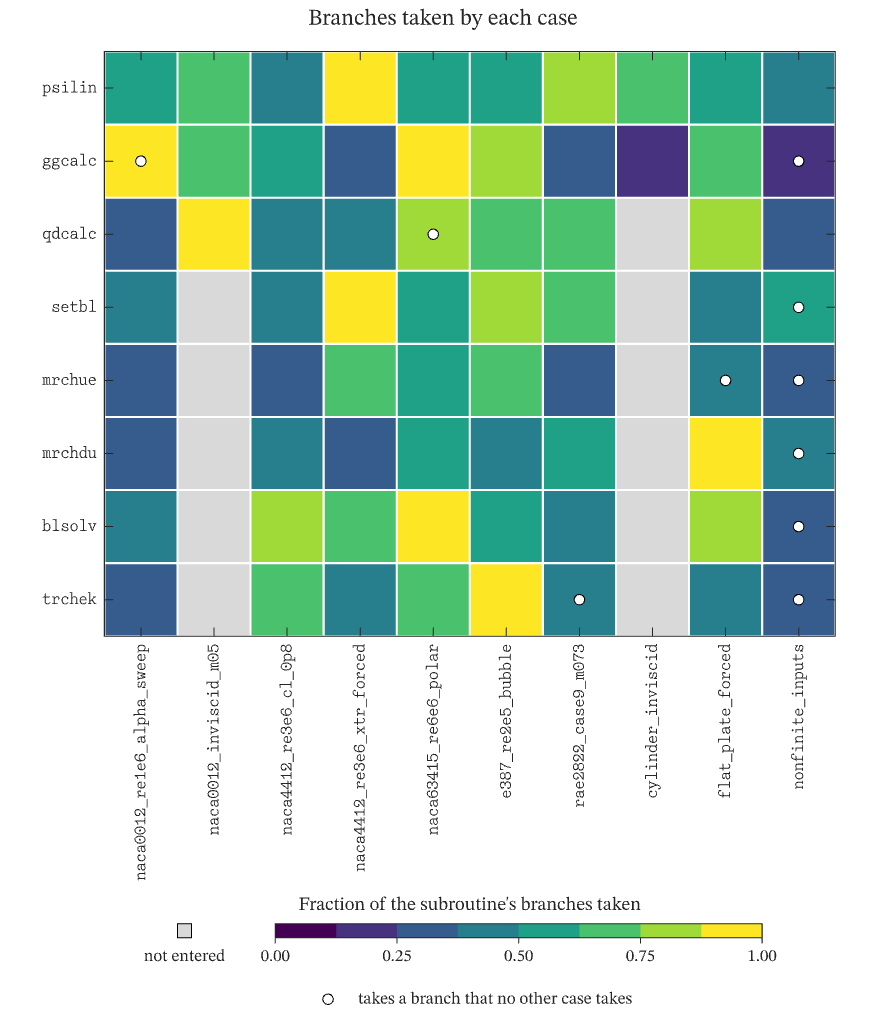
The figure above is live, drawn in the browser by the same engine that draws the viewer: drag it to pan, and click it to zoom with the wheel. Download the PDF for the vector figure that IronLAB exports, or read how to embed a figure of your own.
Source
The figure is built by the following code.
use ironlab::prelude::*;

pub const TITLE: &str = "Case by subroutine coverage matrix";
pub const DESCRIPTION: &str = "The fraction of the branches of each subroutine of a synthetic panel-method code \
     that each test case takes, one column per case and one row per subroutine. The cases are named by their \
     identifiers, set in monospace with `\\texttt` and turned by 90° so that they stand clear of one another; the \
     layout reserves the height they take, so none is clipped. The cells are drawn through a discrete colour scale \
     of eight bands an eighth wide, shown by a horizontal colourbar in a panel under the plot, and they are square, \
     because the axes is drawn at equal aspect. A subroutine that a case never entered has no fraction, so its \
     value is NaN; the scale draws it in a neutral grey, and the colourbar's non-finite key, labelled \"not \
     entered\", keys it. White dots mark the cells in which a case takes a branch that no other case takes, and a \
     legend panel under the colourbar names them.";

/// The test cases, one per column.
const CASES: [&str; 10] = [
    "naca0012_re1e6_alpha_sweep",
    "naca0012_inviscid_m05",
    "naca4412_re3e6_cl_0p8",
    "naca4412_re3e6_xtr_forced",
    "naca63415_re6e6_polar",
    "e387_re2e5_bubble",
    "rae2822_case9_m073",
    "cylinder_inviscid",
    "flat_plate_forced",
    "nonfinite_inputs",
];

/// The subroutines, one per row.
const SUBROUTINES: [&str; 8] = [
    "psilin", "ggcalc", "qdcalc", "setbl", "mrchue", "mrchdu", "blsolv", "trchek",
];

/// Which subroutines are entered by every case: an inviscid case never enters the boundary-layer routines.
fn entered(case: &str, subroutine: &str) -> bool {
    let viscous = ["setbl", "mrchue", "mrchdu", "blsolv", "trchek"].contains(&subroutine);
    let inviscid = case.contains("inviscid");
    !(viscous && inviscid) && !(subroutine == "qdcalc" && case.contains("cylinder"))
}

/// A small deterministic generator, so that the fractions are the same on every run.
struct Lcg(u64);

impl Lcg {
    /// Returns a number drawn from `[0, 1)`.
    fn unit(&mut self) -> f64 {
        self.0 = self
            .0
            .wrapping_mul(6_364_136_223_846_793_005)
            .wrapping_add(1_442_695_040_888_963_407);
        (self.0 >> 11) as f64 / (1u64 << 53) as f64
    }
}

pub fn figure() -> Figure {
    let mut rng = Lcg(153);
    let mut unique = (Vec::new(), Vec::new());
    let fraction = Matrix::from_fn(SUBROUTINES.len(), CASES.len(), |row, col| {
        if !entered(CASES[col], SUBROUTINES[row]) {
            return f64::NAN;
        }
        // The non-finite case exercises the guards, which the ordinary cases skip, so it takes a branch that no
        // other case takes in most of the subroutines it enters.
        let guards = CASES[col] == "nonfinite_inputs";
        if (guards && rng.unit() < 0.75) || rng.unit() < 0.08 {
            unique.0.push(col as f64);
            unique.1.push(row as f64);
        }
        let (least, spread) = if guards { (0.1, 0.5) } else { (0.2, 0.8) };
        least + spread * rng.unit()
    });

    let mut fig = Figure::new()
        .size_mm(150.0, 175.0)
        .tiles(3, 1)
        .fit_row(1)
        .fit_row(2)
        .title("Branches taken by each case")
        .tag("cells")
        .tag("scatter")
        .tag("color-scale")
        .tag("colorbar")
        .tag("legend")
        .tag("categorical")
        .tag("ticks")
        .tag("aspect")
        .tag("simulations")
        .tag("occupancy")
        .tag("heatmap")
        .tag("tick-angle")
        .tag("coverage")
        .tag("testing")
        .parameter("dimensionality", "2D")
        .parameter("artists", 2)
        .parameter("data_points", 100)
        .parameter("has_legend", true);
    let edges: Vec<f64> = (0..=8).map(|k| f64::from(k) / 8.0).collect();
    let taken = fig
        .color_scale()
        .colormap(Colormap::Viridis)
        .discrete(&edges)
        .tick_step(0.25)
        .non_finite(Color::rgb(0.85, 0.85, 0.85))
        .key_label(ColorScaleKey::NonFinite, "not entered")
        .title("Fraction of the subroutine's branches taken")
        .id();
    let key = fig.panel(2, 0).legend().boxed(false).id();

    let mut ax = fig.axes(0, 0);
    ax.cells(&fraction)
        .color_scale(taken)
        .edge_color(Color::WHITE)
        .edge_width(1.0);
    ax.scatter(&unique.0, &unique.1)
        .label("takes a branch that no other case takes")
        .marker(Marker::Circle)
        .marker_size(5.0)
        .marker_face(Color::WHITE)
        .marker_edge(Color::BLACK);
    ax.xcategories(CASES.map(|case| format!(r"\texttt{{{case}}}")))
        .xtick_label_angle(90.0)
        .ycategories(SUBROUTINES.map(|name| format!(r"\texttt{{{name}}}")))
        .aspect(Aspect::Equal)
        .legend_in(key);

    fig.panel(1, 0)
        .colorbar(taken)
        .orientation(ColorbarOrientation::Horizontal)
        .title_placement(ColorbarTitlePlacement::Above)
        .length(0.8);
    fig
}