Equal aspect in three dimensions
A unit sphere shown with limits of unequal span, x and z from −1 to 1 and y from −2.5 to 2.5. With an automatic aspect the box stays a cube, so the sphere is squashed along y; at equal aspect kept by the box, the limits are kept and the sides of the box take the lengths of the ranges, so that one unit has the same length along x, y and z and the sphere is round from every view, however the figure is rotated. The third panel draws a low hill at a ratio of z of 4, the vertical exaggeration of a terrain map, so that its box is four times as tall as the hill's height alone would make it.
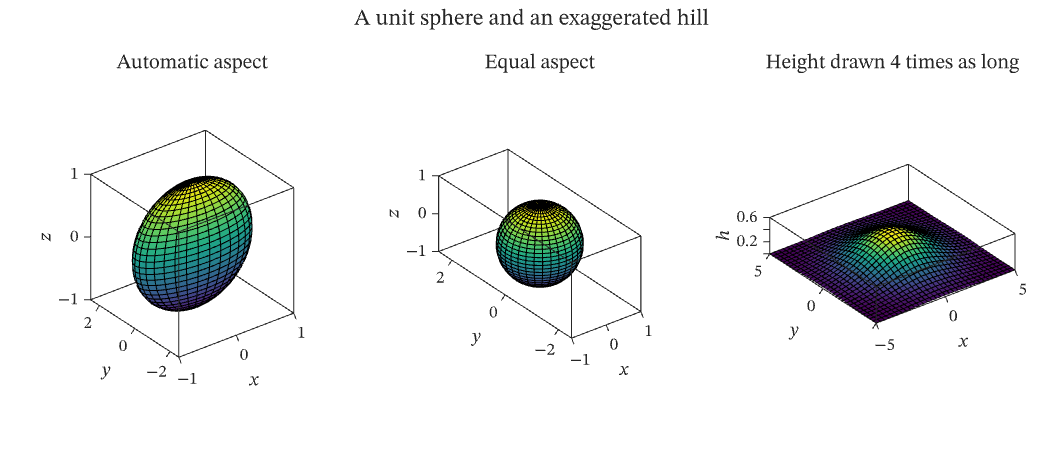
The figure above is live, drawn in the browser by the same engine that draws the viewer: drag it to pan, and click it to zoom with the wheel. Download the PDF for the vector figure that IronLAB exports, or read how to embed a figure of your own.
Source
The figure is built by the following code.
use ironlab::prelude::*;

pub const TITLE: &str = "Equal aspect in three dimensions";
pub const DESCRIPTION: &str = "A unit sphere shown with limits of unequal span, x and z from −1 to 1 and y from \
     −2.5 to 2.5. With an automatic aspect the box stays a cube, so the sphere is squashed along y; at equal aspect \
     kept by the box, the limits are kept and the sides of the box take the lengths of the ranges, so that one unit \
     has the same length along x, y and z and the sphere is round from every view, however the figure is rotated. \
     The third panel draws a low hill at a ratio of z of 4, the vertical exaggeration of a terrain map, so that its \
     box is four times as tall as the hill's height alone would make it.";

/// The number of rows and columns of the grids of the sphere and of the hill.
const N: usize = 33;

pub fn figure() -> Figure {
    let mut fig = Figure::new()
        .size_mm(180.0, 80.0)
        .tiles(1, 3)
        .title("A unit sphere and an exaggerated hill")
        .tag("surface")
        .tag("subplots")
        .tag("aspect")
        .parameter("dimensionality", "3D")
        .parameter("artists", 3)
        .parameter("data_points", (2 * 3 * N * N + 2 * N + N * N) as i64)
        .parameter("has_legend", false);

    // The sphere, parametrised by the polar angle along the rows and the azimuth along the columns.
    let polar = |row: usize| std::f64::consts::PI * row as f64 / (N - 1) as f64;
    let azimuth = |col: usize| std::f64::consts::TAU * col as f64 / (N - 1) as f64;
    let x = Matrix::from_fn(N, N, |row, col| polar(row).sin() * azimuth(col).cos());
    let y = Matrix::from_fn(N, N, |row, col| polar(row).sin() * azimuth(col).sin());
    let z = Matrix::from_fn(N, N, |row, _| polar(row).cos());
    for (col, (aspect, title)) in [
        (Aspect::Auto, "Automatic aspect"),
        (Aspect::Equal, "Equal aspect"),
    ]
    .into_iter()
    .enumerate()
    {
        let mut ax = fig.axes(0, col as u32);
        ax.surf(x.clone(), y.clone(), &z);
        ax.title(title)
            .aspect(aspect)
            .xlim(-1.0, 1.0)
            .ylim(-2.5, 2.5)
            .zlim(-1.0, 1.0)
            .xlabel("$x$")
            .ylabel("$y$")
            .zlabel("$z$");
    }

    // A hill 0.5 high over a square 10 wide, drawn at four times its height.
    let ground = linspace(-5.0, 5.0, N);
    let hill = Matrix::from_fn(N, N, |row, col| {
        let (x, y) = (ground[col], ground[row]);
        0.5 * (-(x * x + y * y) / 8.0).exp()
    });
    let mut ax = fig.axes(0, 2);
    ax.surf(ground.clone(), ground, &hill);
    ax.title("Height drawn 4 times as long")
        .aspect(Aspect::Ratio { y: 1.0, z: 4.0 })
        .xlabel("$x$")
        .ylabel("$y$")
        .zlabel("$h$");
    fig
}