Measured speed faded by its confidence
The speed of the flow past a cylinder as a particle image velocimetry measurement might report it, with a validation confidence for every vector: low next to the wall, where reflections spoil the particle images, and lower still in the shadow that the cylinder casts in the laser sheet, which enters from above. On the left the confidence is the alpha of a colour-mapped image, so that each pixel fades as far as its vector is doubtful, and the inside of the cylinder, where nothing was measured, is transparent. On the right the same speed is a surface over its own contours: the confidence is the alpha of the faces, and a face opacity below one lets the contours on the floor show through the whole surface. Alpha has the shape of the data and varies over it; opacity is one number for the whole artist, which the viewer's property editor can change without regenerating any data.
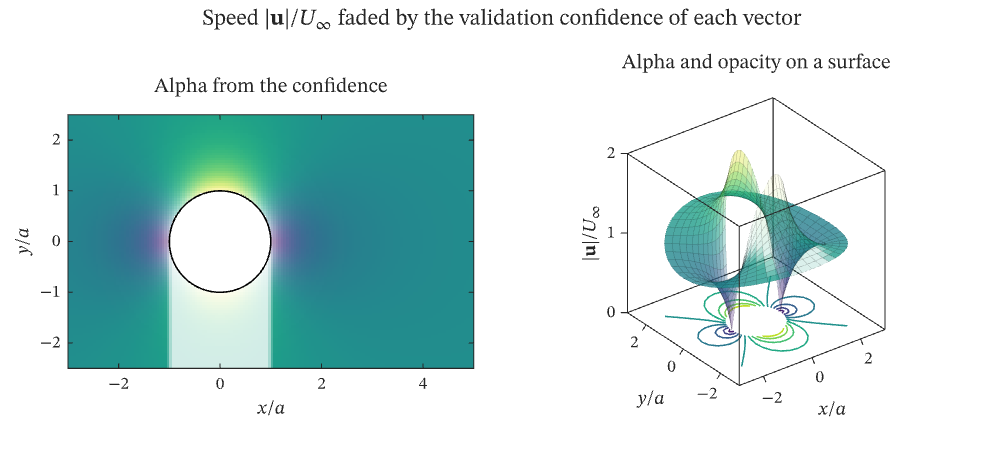
The figure above is live, drawn in the browser by the same engine that draws the viewer: drag it to pan, and click it to zoom with the wheel. Download the PDF for the vector figure that IronLAB exports, or read how to embed a figure of your own.
Source
The figure is built by the following code. Its data comes from the functions on the data helpers page.
use ironlab::prelude::*;

use crate::fields::*;

pub const TITLE: &str = "Measured speed faded by its confidence";
pub const DESCRIPTION: &str = "The speed of the flow past a cylinder as a particle image velocimetry measurement \
     might report it, with a validation confidence for every vector: low next to the wall, where reflections spoil \
     the particle images, and lower still in the shadow that the cylinder casts in the laser sheet, which enters from \
     above. On the left the confidence is the alpha of a colour-mapped image, so that each pixel fades as far as its \
     vector is doubtful, and the inside of the cylinder, where nothing was measured, is transparent. On the right \
     the same speed is a surface over its own contours: the confidence is the alpha of the faces, and a face opacity \
     below one lets the contours on the floor show through the whole surface. Alpha has the shape of the data and \
     varies over it; opacity is one number for the whole artist, which the viewer's property editor can change \
     without regenerating any data.";

/// The number of pixels of the image along x and along y.
const NX: usize = 160;
const NY: usize = 100;

/// The extent of the measurement along x and along y, in cylinder radii.
const X_RANGE: (f64, f64) = (-3.0, 5.0);
const Y_RANGE: (f64, f64) = (-2.5, 2.5);

/// The number of rings and spokes of the polar mesh of the surface, and the radius of its outermost ring.
const RINGS: usize = 13;
const SPOKES: usize = 49;
const OUTER_RADIUS: f64 = 3.0;

/// The validation confidence of a vector measured at `(x, y)`, from 0 (worthless) to 1 (certain), or NaN inside
/// the cylinder, where there is no fluid and so no vector.
///
/// Reflections from the wall lower the confidence within a few tenths of a radius of it, and the cylinder shadows
/// the laser sheet beneath it, where the particles are lit only by scattered light.
fn confidence(x: f64, y: f64) -> f64 {
    let r = x.hypot(y);
    if r < 1.0 {
        return f64::NAN;
    }
    let reflection = 1.0 - 0.7 * (-(r - 1.0) / 0.25).exp();
    let across = ((1.05 - x.abs()) / 0.1).clamp(0.0, 1.0);
    let below = ((-y) / 0.3).clamp(0.0, 1.0);
    let shadow = 1.0 - 0.8 * across * below;
    reflection * shadow
}

/// The speed of the flow at `(x, y)` in units of the free-stream speed, or NaN inside the cylinder.
fn speed(x: f64, y: f64) -> f64 {
    cylinder_flow_speed(x.hypot(y), y.atan2(x))
}

pub fn figure() -> Figure {
    let pitch_x = (X_RANGE.1 - X_RANGE.0) / NX as f64;
    let pitch_y = (Y_RANGE.1 - Y_RANGE.0) / NY as f64;
    let xs = linspace(X_RANGE.0 + pitch_x / 2.0, X_RANGE.1 - pitch_x / 2.0, NX);
    let ys = linspace(Y_RANGE.0 + pitch_y / 2.0, Y_RANGE.1 - pitch_y / 2.0, NY);
    let measured = Matrix::from_fn(NY, NX, |row, col| speed(xs[col], ys[row]));
    let trust = Matrix::from_fn(NY, NX, |row, col| confidence(xs[col], ys[row]));

    let (mesh_x, mesh_y, mesh_speed) = cylinder_flow_mesh(RINGS, SPOKES, OUTER_RADIUS);
    let mesh_trust = Matrix::from_fn(RINGS, SPOKES, |row, col| {
        confidence(mesh_x[(row, col)], mesh_y[(row, col)])
    });

    let mut fig = Figure::new()
        .size_mm(170.0, 80.0)
        .tiles(1, 2)
        .title(r"Speed $|\mathbf{u}| / U_\infty$ faded by the validation confidence of each vector")
        .tag("image")
        .tag("surface")
        .tag("contour")
        .tag("line")
        .tag("subplots")
        .tag("transparency")
        .parameter("dimensionality", "3D")
        .parameter("artists", 4)
        .parameter("data_points", 36_701)
        .parameter("has_legend", false);

    let mut ax = fig.axes(0, 0);
    // The confidence is the alpha of every pixel: a pixel of confidence 0.3 is drawn at 30 % of its colour over the
    // white of the axes. The NaN confidence inside the cylinder makes those pixels transparent, as their NaN speed
    // already does.
    ax.scalar_image(&measured)
        .pixel_columns(xs[0], xs[NX - 1])
        .pixel_rows(ys[0], ys[NY - 1])
        .alpha(&trust);
    let circle: Vec<f64> = linspace(0.0, std::f64::consts::TAU, 121);
    ax.plot(
        circle.iter().map(|t| t.cos()).collect::<Vec<_>>(),
        circle.iter().map(|t| t.sin()).collect::<Vec<_>>(),
    )
    .color(Color::BLACK)
    .line_width(0.75);
    // A speed beyond the limits of the scale is left undrawn rather than clamped to an end colour.
    ax.color_scale()
        .limits(0.0, 2.0)
        .below(OutOfRange::Transparent)
        .above(OutOfRange::Transparent);
    ax.aspect(Aspect::Equal)
        .xlabel("$x / a$")
        .ylabel("$y / a$")
        .title("Alpha from the confidence");

    let mut ax = fig.axes3(0, 1);
    // The contours lie on the floor of the box, beneath the surface of the same speed.
    ax.contour(mesh_x.clone(), mesh_y.clone(), &mesh_speed)
        .levels(12)
        .line_width(0.75);
    // The faces take the confidence at their corners as their alpha, and the face opacity multiplies it, so that even
    // the most trusted faces let the contours beneath them show; the mesh lines are fainter still.
    ax.surf(mesh_x, mesh_y, &mesh_speed)
        .face_alpha(&mesh_trust)
        .face_opacity(0.8)
        .edge_opacity(0.25)
        .edge_width(0.25);
    ax.color_scale().limits(0.0, 2.0);
    ax.zlim(0.0, 2.0)
        .xlabel("$x / a$")
        .ylabel("$y / a$")
        .zlabel(r"$|\mathbf{u}| / U_\infty$")
        .title("Alpha and opacity on a surface");
    fig
}