Reference and variants
The lift, drag and pitching-moment coefficients of a synthetic aerofoil polar at a base case and at six levels of an input perturbation, in a stack of three plots that share the angle of attack. The base case is drawn last, so that the family never hides it, but the key beneath the plots lists it first, on a row of its own, followed by the perturbation levels in columns. The key sits in a row fitted to its entries, so it neither clips them nor takes more height than they need.
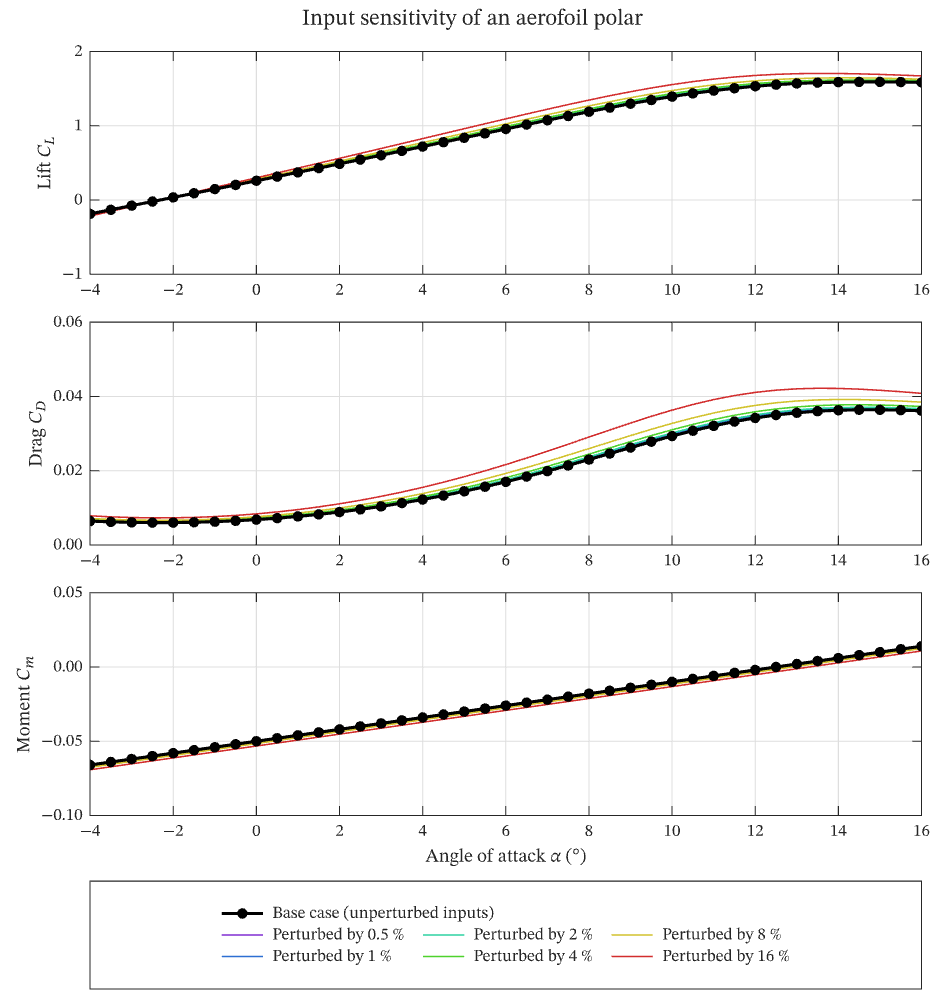
The figure above is live, drawn in the browser by the same engine that draws the viewer: drag it to pan, and click it to zoom with the wheel. Download the PDF for the vector figure that IronLAB exports, or read how to embed a figure of your own.
Source
The figure is built by the following code. Its data comes from the functions on the data helpers page.
use ironlab::prelude::*;

use crate::fields::hsl_to_rgb;

pub const TITLE: &str = "Reference and variants";
pub const DESCRIPTION: &str = "The lift, drag and pitching-moment coefficients of a synthetic aerofoil polar at a \
     base case and at six levels of an input perturbation, in a stack of three plots that share the angle of attack. \
     The base case is drawn last, so that the family never hides it, but the key beneath the plots lists it first, on \
     a row of its own, followed by the perturbation levels in columns. The key sits in a row fitted to its entries, \
     so it neither clips them nor takes more height than they need.";

/// The perturbation levels, in per cent of the input.
const LEVELS: [f64; 6] = [0.5, 1.0, 2.0, 4.0, 8.0, 16.0];

/// Returns the lift coefficient at angle of attack `alpha` (in degrees) of a section whose lift slope is scaled by
/// `slope` and which stalls gradually above 12°.
fn lift(alpha: f64, slope: f64) -> f64 {
    let linear = 2.0 * std::f64::consts::PI * alpha.to_radians() * slope;
    let stall = 1.0 / (1.0 + ((alpha - 12.0) / 2.5).exp());
    0.25 * slope + linear * stall + (1.0 - stall) * 1.25
}

pub fn figure() -> Figure {
    let alpha = linspace(-4.0, 16.0, 41);

    let mut fig = Figure::new()
        .size_mm(160.0, 170.0)
        .tiles(4, 1)
        .fit_row(3)
        .title("Input sensitivity of an aerofoil polar")
        .tag("line")
        .tag("subplots")
        .tag("legend")
        .tag("markers")
        .tag("simulations")
        .parameter("dimensionality", "2D")
        .parameter("artists", 21)
        .parameter("data_points", 1722)
        .parameter("has_legend", true);
    let key = fig.panel(3, 0).id();

    // The levels are drawn first, from the smallest perturbation in pale violet to the largest in red, and the base
    // case last, in black with filled markers, so that it lies on top of the family.
    let ramp = |k: usize| hsl_to_rgb(0.75 * (1.0 - k as f64 / 5.0), 0.65, 0.5);
    let mut levels = Vec::new();
    let mut base = None;
    for (row, quantity) in ["lift", "drag", "moment"].into_iter().enumerate() {
        let curve = |slope: f64| -> Vec<f64> {
            alpha
                .iter()
                .map(|&a| {
                    let cl = lift(a, slope);
                    match quantity {
                        "lift" => cl,
                        "drag" => 0.006 + 0.008 * (slope - 1.0).abs() + 0.012 * cl * cl,
                        _ => -0.05 - 0.02 * (slope - 1.0) + 0.004 * a,
                    }
                })
                .collect()
        };
        let mut ax = fig.axes(row as u32, 0);
        for (k, level) in LEVELS.into_iter().enumerate() {
            let id = ax
                .plot(&alpha, curve(1.0 + level / 100.0))
                .label(format!("Perturbed by {level} %"))
                .color(ramp(k))
                .id();
            if row == 0 {
                levels.push(id);
            }
        }
        let id = ax
            .plot(&alpha, curve(1.0))
            .label("Base case (unperturbed inputs)")
            .color(Color::rgb(0.0, 0.0, 0.0))
            .line_width(1.5)
            .marker(Marker::Circle)
            .marker_size(3.5)
            .marker_face(Color::rgb(0.0, 0.0, 0.0))
            .id();
        base.get_or_insert(id);
        ax.grid(true).legend_in(key);
    }
    fig.axes(0, 0).ylabel("Lift $C_L$");
    fig.axes(1, 0).ylabel("Drag $C_D$");
    fig.axes(2, 0)
        .ylabel("Moment $C_m$")
        .xlabel(r"Angle of attack $\alpha$ (°)");
    fig.link_all_x()
        .expect("every axes of the figure can be linked");

    // The key names the artists of the top plot; each item also stands for the artists of the same name and look in
    // the other plots, so clicking it in the viewer hides or shows that case in all three.
    let mut panel = fig.panel(3, 0);
    let mut key = panel.legend();
    key.full_row(base.expect("the figure has a base case"));
    for id in levels {
        key.item(id);
    }
    fig
}